更新する-信頼的な3V0-25.25英語版試験-試験の準備方法3V0-25.25勉強ガイド
Wiki Article
さらに、CertShiken 3V0-25.25ダンプの一部が現在無料で提供されています:https://drive.google.com/open?id=1dR_m184PNjUxn8a-VTNHbi26wDFSTf-6
3V0-25.25試験問題のさまざまなバージョンを知りたい場合があります。まず、PDFバージョンは読みやすく、印刷しやすいです。次に、ソフトウェアバージョンは実際の3V0-25.25実際のテストガイドをシミュレートしますが、Windowsオペレーティングシステムでのみ実行できます。第三に、オンライン版はあらゆる電子機器をサポートし、オフライン使用もサポートします。初めて、オンライン環境で3V0-25.25試験問題を開く必要があり、それをオフラインで使用できます。全体として、受験者が試験に合格するのを支援することが常に求められています。 3V0-25.25実際のテストガイドが最適です。
VMware 3V0-25.25 認定試験の出題範囲:
| トピック | 出題範囲 |
|---|---|
| トピック 1 |
|
| トピック 2 |
|
| トピック 3 |
|
| トピック 4 |
|
| トピック 5 |
|
便利なVMware 3V0-25.25英語版 & 合格スムーズ3V0-25.25勉強ガイド | 実用的な3V0-25.25リンクグローバル
あらゆる人にとって、時間は非常に大切です。3V0-25.25試験に対して、いろいろな資料があります。そのような資料を勉強するには、長い時間がかかります。でも、3V0-25.25問題集を利用すれば、短い時間で3V0-25.25試験に合格できます。そして、3V0-25.25問題集は安くて、便利です。誰でも、3V0-25.25問題集を選択すれば、試験に合格する可能性が大きいです。もし、3V0-25.25問題集を勉強すれば、もし、将来にITエリートになります。
VMware Advanced VMware Cloud Foundation 9.0 Networking 認定 3V0-25.25 試験問題 (Q57-Q62):
質問 # 57
An administrator has a standalone vSphere 8.0 Update 1a deployment that is running with VMware NSX
4.1.0.2 and has to converge the deployment into a new VMware Cloud Foundation (VCF) instance. How can the administrator accomplish this task?
- A. Manually upgrade both vSphere and NSX to version 9 prior to converging. Then use the VCF Installer to converge the vSphere 9 and NSX 9 instances into a new VCF management domain.
- B. Manually upgrade vSphere to version 9. Then use the VCF Installer to converge the vSphere 9 environment into a new VCF management domain. Then use the VCF lifecycle management tools to upgrade NSX to version 9.
- C. Manually upgrade vSphere to version 9 and uninstall NSX 4. Then use the VCF Installer to converge the vSphere 9.0 environment into a new VCF management domain at which time NSX 9 will be reinstalled.
- D. Use the VCF Installer to converge the existing vSphere 8 and NSX 4 environment into a new VCF management domain. Then use the VCF lifecycle management tools to upgrade to 9.
正解:D
解説:
Comprehensive and Detailed 250 to 350 words of Explanation From VMware Cloud Foundation (VCF) documents:
The process of bringing existing infrastructure under VCF management is known as"VCF Import"or
"Convergence."This is a common path for organizations transitioning from siloed management to the full SDDC stack provided by Cloud Foundation.
According to the VCF 5.x and 9.0 documentation, theVCF Installer(specifically the Cloud Foundation Builder and the Import Tool) is designed to ingest existing environments. The verified best practice is to converge the environment at its current, supported version, provided it meets the minimum baseline requirements for the VCF version you are deploying.
In this scenario, vSphere 8.0 U1 and NSX 4.1 are compatible versions that can be imported into a VCF management framework. By using theVCF Installerto converge the existing environment first (Option C), the SDDC Manager takes ownership of the existing vCenter and NSX Manager. Once the environment is
"VCF-aware," the administrator gains the benefit ofSDDC Manager's Lifecycle Management (LCM).
The SDDC Manager then handles the orchestrated, multi-step upgrade to version 9.0. This ensures that the automated "Bill of Materials" (BOM) is strictly followed, ensuring compatibility between vCenter, ESXi, and NSX components. Attempting to manually upgrade components to version 9beforeconvergence (Options A and B) or uninstalling NSX (Option D) creates a "Frankenstein" environment that may not align with the VCF BOM, making the automated convergence process fail or resulting in an unsupported configuration. The principle of VCF is tobring the environment in first, then let VCF manage the upgrades.
質問 # 58
An administrator is preparing to deploy a new workload domain that will host vSphere Kubernetes Service (VKS) clusters. Before configuring the network for the Kubernetes clusters, the administrator needs to create a Tier-0 Gateway to handle North/South connectivity. What is the requirement for creating a Tier-0 Gateway for use with a workload domain that is running the vSphere Kubernetes service (VKS) with VPC?
- A. The Tier-0 Gateway must be configured in Active/Standby mode.
- B. The Tier-0 Gateway must have IPv6 enabled.
- C. The Tier-0 Gateway must be configured in Non-Preemptive failover mode.
- D. The Tier-0 Gateway route map must contain an IP prefix with only a deny rule.
正解:A
解説:
Comprehensive and Detailed 250 to 350 words of Explanation From VMware Cloud Foundation (VCF) documents:
When deployingvSphere Kubernetes Service (VKS)-often referred to as Tanzu with VCF-within a Virtual Private Cloud (VPC)consumption model, the networking requirements are more stringent than a standard VM-only environment. This is because VKS relies on stateful services such asLoad Balancing(via the NSX Advanced Load Balancer or the native NSX LB) andNATto provide ingress and egress for Kubernetes pods and services.
In NSX architecture, any gateway that providesstateful servicesmust be configured inActive/Standbymode.
While an Active/Active Tier-0 gateway is excellent for high-throughput ECMP routing, it cannot support stateful features because return traffic might arrive at the "Standby" (or alternative Active) node which does not share the same session state table, resulting in dropped connections.
Specifically, for VKS clusters integrated with the VPC model in VCF 5.x and 9.0, the Tier-0 gateway acts as the provider-side gateway. To ensure that the KubernetesLoadBalancerservice types andSNAT/DNATfor pods function correctly and maintain session persistence, the gateway must be anchored to a specific Service Router (SR) on an Edge node. This is only possible in anActive/Standbyconfiguration.
Option B (Non-Preemptive) is a failoversettingbut not the primary architectural requirement. Option D (IPv6) may be used depending on the specific network design, but it is not a mandatory requirement for VKS functionality. Option A is incorrect as route maps usually require "Permit" rules to actually function. Thus, the verified architectural prerequisite for a VKS/VPC-enabled workload domain is anActive/Standby Tier-0 Gateway.
質問 # 59
An administrator is enabling IPv6-to-IPv4 communication for workloads hosted in an NSX environment. The workloads use IPv6-only addressing, but the external systems they must reach are IPv4-only. To provide this translation service, the administrator decides to configure NAT64. Which two following characteristics about NAT64 are true? (Choose two.)
- A. NAT64 is stateless and requires gateways to be deployed in active-standby mode.
- B. NAT64 is supported on Tier-1 gateways only.
- C. NAT64 requires the Tier-1 gateway to be configured in active-standby mode.
- D. NAT64 requires the Tier-1 gateway to be configured in active-active mode.
- E. NAT64 is supported on Tier-0 and Tier-1 gateways.
正解:C、E
解説:
Comprehensive and Detailed 250 to 350 words of Explanation From VMware Cloud Foundation (VCF) documents:
As organizations modernize their infrastructure withVCF 5.x and 9.0, IPv6 adoption becomes more prevalent.
NAT64is a critical transition technology that allows IPv6-only hosts to communicate with IPv4-only resources by translating the packet headers.
In NSX, NAT64 is astateful service. Stateful services in the NSX architecture require a centralized point of processing to maintain the session state table. Because of this requirement, any gateway (Tier-0 or Tier-1) providing NAT64 servicesmust be configured in Active-Standby high availability mode. In Active-Active mode, asymmetric return traffic could hit a different Edge node that does not have the session information, causing the translation to fail. This is a fundamental design constraint for stateful NAT in NSX.
Furthermore, VMware NSX documentation specifies that NAT64 is a flexible service that can be implemented at multiple tiers of the logical routing hierarchy. It issupported on both Tier-0 and Tier-1 gateways. The choice of where to place the NAT64 service depends on the design requirements: placing it on the Tier-1 gateway allows for tenant-specific translation and offloads the Tier-0, while placing it on the Tier-0 provides a centralized translation point for all connected segments.
Option A is incorrect because NAT64 in NSX is stateful, not stateless. Option C is incorrect because it is not limited to Tier-1. Option E is incorrect because Active-Active mode does not support the stateful nature of the NAT64 engine. Consequently, the correct architecture requires anActive-Standbyconfiguration on either a Tier-0 or Tier-1gateway to properly facilitate the translation between the IPv6 workloads and the IPv4 external world.
質問 # 60
An administrator has noticed that both the active and standby Global Managers have gone offline.
What is the correct sequence of events to restore the Global Managers?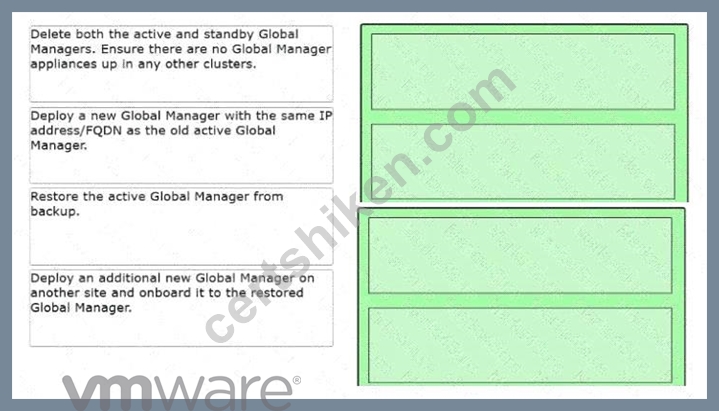
正解:
解説: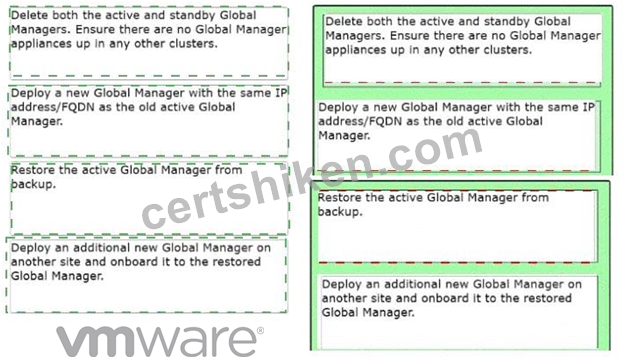
Explanation:
* Step 1: Delete both the active and standby Global Managers. Ensure there are no Global Manager appliances up in any other clusters.
* Step 2: Deploy a new Global Manager with the same IP address/FQDN as the old active Global Manager.
* Step 3: Restore the active Global Manager from backup.
* Step 4: Deploy an additional new Global Manager on another site and onboard it to the restored Global Manager.
In aVMware Cloud Foundationmulti-site deployment usingNSX Federation, the Global Manager (GM) manages the global networking configuration across multiple sites. If the entire GM cluster (Active and Standby) fails, the following architectural principles apply:
* Cleanup (Step 1):Before initiating a restore, the environment must be "cleaned." If old, failed VMs remain in the inventory or on the hosts, they can cause IP address conflicts or UUID mismatches during the deployment of the new appliance. You must ensure the management plane is clear of the original failed nodes.
* Identity Consistency (Step 2):When restoring an NSX appliance (Local or Global) from backup, the new appliancemustbe deployed with the exact sameIP address and FQDNas the original active node.
This is critical because the existing Local Managers (LMs) at each site already have established thumbprints and communication channels tied to that specific identity.
* The Restore Operation (Step 3):Once the "seed" appliance is deployed, the restore process is triggered through the NSX Manager UI/API. This process re-populates the database with the global segments, firewall rules, and Tier-0/Tier-1 configurations.
* Restoring Redundancy (Step 4):The backup only contains the configuration of the cluster. It does not
"restore" the standby VM itself. High Availability (HA) must be manually re-established by deploying a second GM appliance at the secondary site and joining it to the newly restored Global Manager cluster to act as the standby.
質問 # 61
An administrator is troubleshooting why workloads in NSX cannot reach the external network 10.100.0.0/16.
The Tier-0 Gateway is in Active/Active mode and has the following configuration:
* Uplink-1 (VLAN 100): 192.168.100.0/24 -> router R1 at 192.168.100.1
* Uplink-2 (VLAN 101): 192.168.101.0/24 -> router R2 at 192.168.101.1
* A static route for 10.100.0.0/16 was added with both next-hops (192.168.100.1 and 192.168.101.1).
* The Scope of this route is set to Uplink-1.
Symptoms:
* Virtual Machines (VMs) cannot reach 10.100.0.0/16
* Traceroute from the VM stops at the Tier-0 gateway with "Destination Net Unreachable"
* Pings from the Edge nodes to both 192.168.100.1 and 192.168.101.1 are success What explains why workloads in NSX cannot reach the external network?
- A. The static route Scope is set to only one uplink interface, but the next-hops are on two different VLANs.
- B. Static routes do not support Equal Cost Multi-Pathing (ECMP) in NSX.
- C. The physical routers are missing return routes.
- D. The next-hops should have been configured as the Tier-0's own uplink IPs instead of the routers IPs.
正解:A
解説:
Comprehensive and Detailed 250 to 350 words of Explanation From VMware Cloud Foundation (VCF) documents:
Troubleshooting routing in a VMware Cloud Foundation (VCF) environment requires a deep understanding of how theNSX Tier-0 Gatewayprocesses forwarding entries. In anActive/Activeconfiguration, the Tier-0 gateway is designed to utilize ECMP (Equal Cost Multi-Pathing) to distribute traffic across multiple paths to the physical network.
The specific failure described-where a traceroute fails at the Tier-0 with "Destination Net Unreachable" despite the Edge nodes having basic ping connectivity to the routers-points toward a routing table entry error rather than a physical connectivity issue. In NSX, when a static route is created, an administrator has the option to set a"Scope."The Scope explicitly tells the NSX routing engine which interface should be used to reach the defined next-hops.
In this scenario, the administrator has defined two next-hops (R1 and R2) but has restricted the scope of the static route toUplink-1 only. Because R2 (192.168.101.1) is on a different subnet/VLAN (VLAN 101) that is associated withUplink-2, the Tier-0 gateway cannot resolve the next-hop for R2 via Uplink-1. Furthermore, if the gateway detects an inconsistency between the defined next-hop and the scoped interface, it may invalidate the route or fail to install it correctly in the forwarding information base (FIB) for the service router.
According to VMware documentation, theScopeshould typically be left as "All Uplinks" or carefully matched to the interfaces that have Layer 2 reachability to the next-hop. By scoping it to only Uplink-1, the router R2 becomes unreachable for that specific route entry. Even for R1, if the hashing mechanism of the Active
/Active Tier-0 attempts to use a component of the gateway not associated with that scope, the traffic will fail.
The error "Destination Net Unreachable" at the Tier-0 hop confirms that the Tier-0 has no valid, functional path in its routing table for the 10.100.0.0/16 network due to this scoping conflict.
質問 # 62
......
商品を購入するとき、信頼できる会社を選ぶことができます。我々CertShikenはVMwareの3V0-25.25試験の最高の通過率を保証してVMwareの3V0-25.25ソフトの無料のデモと一年間の無料更新を承諾します。あなたに安心させるために、我々はあなたがVMwareの3V0-25.25試験に失敗したら全額で返金するのを保証します。CertShikenはあなたのVMwareの3V0-25.25試験を準備する間あなたの最もよい友達です。
3V0-25.25勉強ガイド: https://www.certshiken.com/3V0-25.25-shiken.html
- 3V0-25.25模擬対策 ???? 3V0-25.25復習範囲 ???? 3V0-25.25ダウンロード ???? 【 www.japancert.com 】サイトで⮆ 3V0-25.25 ⮄の最新問題が使える3V0-25.25受験記
- 試験の準備方法-素敵な3V0-25.25英語版試験-効率的な3V0-25.25勉強ガイド ???? 今すぐ➤ www.goshiken.com ⮘で「 3V0-25.25 」を検索して、無料でダウンロードしてください3V0-25.25模擬試験
- VMware 3V0-25.25英語版: Advanced VMware Cloud Foundation 9.0 Networking - www.mogiexam.com 無料で試して簡単に購入 ???? 今すぐ⮆ www.mogiexam.com ⮄で☀ 3V0-25.25 ️☀️を検索して、無料でダウンロードしてください3V0-25.25受験記
- 3V0-25.25参考書勉強 ???? 3V0-25.25最新関連参考書 ???? 3V0-25.25受験対策 ???? ⏩ www.goshiken.com ⏪サイトにて最新➥ 3V0-25.25 ????問題集をダウンロード3V0-25.25テスト模擬問題集
- 3V0-25.25テスト模擬問題集 ???? 3V0-25.25最新試験 ???? 3V0-25.25最新試験 ???? サイト{ www.copyright.jp }で“ 3V0-25.25 ”問題集をダウンロード3V0-25.25テスト模擬問題集
- 最新3V0-25.25|一番優秀な3V0-25.25英語版試験|試験の準備方法Advanced VMware Cloud Foundation 9.0 Networking勉強ガイド ???? 今すぐ➽ www.goshiken.com ????を開き、⏩ 3V0-25.25 ⏪を検索して無料でダウンロードしてください3V0-25.25復習範囲
- 3V0-25.25試験の準備方法|更新する3V0-25.25英語版試験|実際的なAdvanced VMware Cloud Foundation 9.0 Networking勉強ガイド ???? { www.jpshiken.com }サイトで✔ 3V0-25.25 ️✔️の最新問題が使える3V0-25.25最新関連参考書
- 3V0-25.25試験の準備方法|更新する3V0-25.25英語版試験|実際的なAdvanced VMware Cloud Foundation 9.0 Networking勉強ガイド ???? Open Webサイト《 www.goshiken.com 》検索⮆ 3V0-25.25 ⮄無料ダウンロード3V0-25.25テストサンプル問題
- 3V0-25.25合格記 ???? 3V0-25.25日本語独学書籍 ???? 3V0-25.25ダウンロード ???? ☀ 3V0-25.25 ️☀️を無料でダウンロード“ www.xhs1991.com ”で検索するだけ3V0-25.25日本語版
- 3V0-25.25日本語版 ???? 3V0-25.25日本語認定 ???? 3V0-25.25最新試験 ???? ▶ www.goshiken.com ◀で▛ 3V0-25.25 ▟を検索し、無料でダウンロードしてください3V0-25.25ダウンロード
- VMwareの3V0-25.25認定試験の最新な問題集 ???? サイト⏩ www.jptestking.com ⏪で➡ 3V0-25.25 ️⬅️問題集をダウンロード3V0-25.25試験問題集
- andrewfpcp301171.wikibyby.com, tomasgplz081848.empirewiki.com, woodyowpg966544.shoutmyblog.com, gerardrueq263914.vigilwiki.com, iwanphoq716551.wikijm.com, saulpirw586521.wikilima.com, safiyampwe744072.mdkblog.com, barbarajkca823841.blog5star.com, chiaranupg792633.blogthisbiz.com, caraobzx242525.wikinstructions.com, Disposable vapes
P.S.CertShikenがGoogle Driveで共有している無料の2026 VMware 3V0-25.25ダンプ:https://drive.google.com/open?id=1dR_m184PNjUxn8a-VTNHbi26wDFSTf-6
Report this wiki page